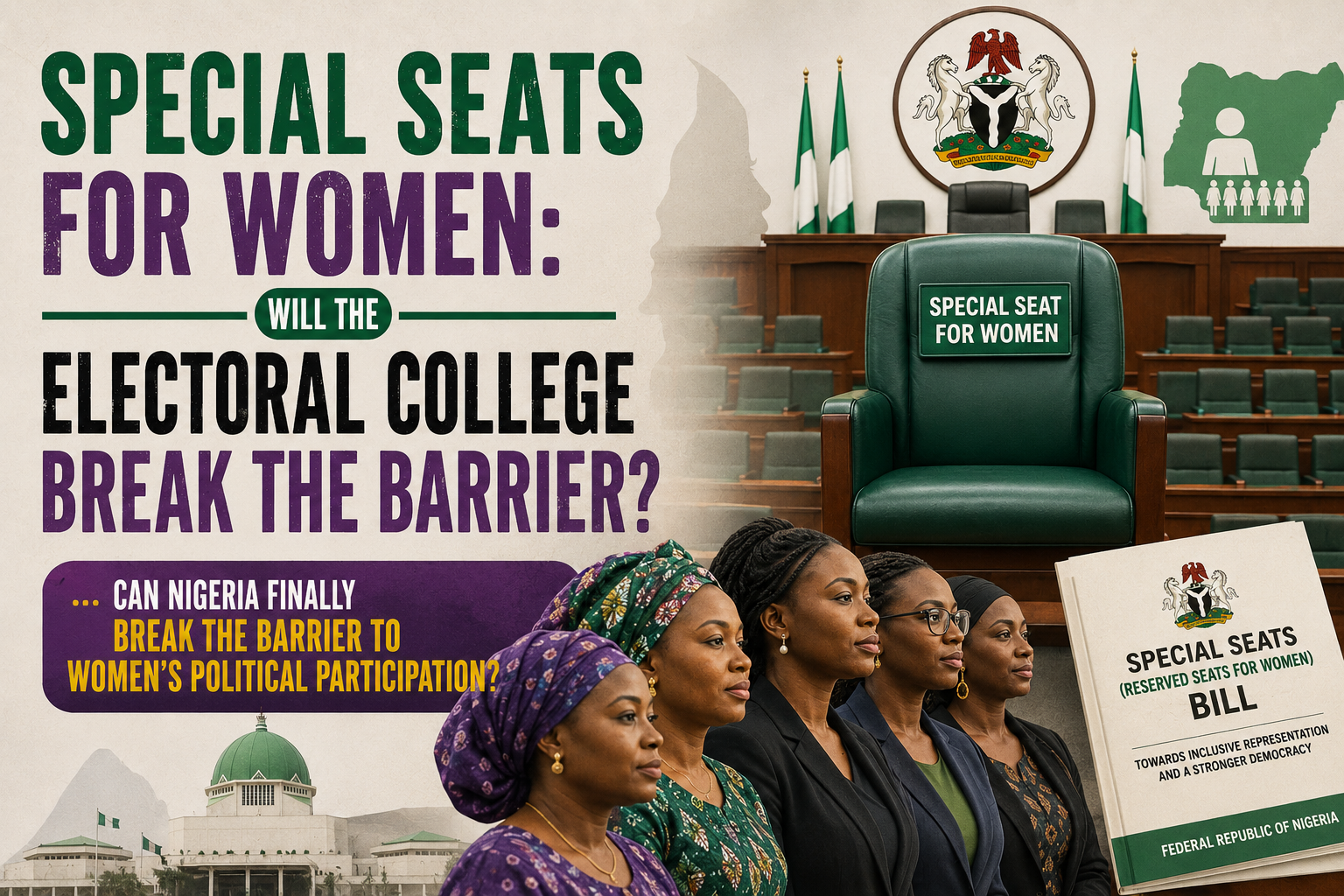
… Can Nigeria Finally Break the Barrier to Women’s Political Participation?
Nigeria stands at a critical constitutional crossroads. The National Assembly is expected to vote on one of the most consequential constitutional amendment proposals currently before it—the Special Seats for Women Bill. If passed, the proposal would represent the most ambitious attempt in Nigeria’s democratic history to address the persistent under-representation of women in elective office.
The Bill seeks to create additional legislative seats reserved exclusively for women in the Senate, House of Representatives and State Houses of Assembly as a temporary affirmative action measure aimed at accelerating women’s participation in governance. Unlike earlier versions of the proposal, however, the current Bill introduces a new mechanism for filling those seats: election through an Electoral College rather than direct voting by the general electorate.
The proposal has generated significant debate. Supporters view it as a practical response to decades of exclusion and structural barriers facing women in politics. Critics question whether indirect elections through Electoral Colleges will truly advance democratic participation and whether the proposal can secure the political support required for constitutional passage.
Whatever the outcome, the Bill has become a defining test of Nigeria’s commitment to inclusive democracy.
Nigeria’s Representation Deficit
Nigeria has one of the lowest rates of women’s political representation in Africa and indeed in the world.
Women constitute approximately half of Nigeria’s population, yet their presence in elected institutions remains strikingly low. Following the 2023 general elections:
- Women occupy less than 5% of seats in the National Assembly.
- Several State Houses of Assembly have no female members at all.
- The Senate has historically recorded extremely low female representation.
- Political party structures remain overwhelmingly dominated by men.
This disparity persists despite decades of constitutional guarantees of equality, national gender policies, international commitments and repeated political promises.
The reality is that formal equality has not translated into equal access to political power.
High nomination costs, political violence, weak party support, patronage networks, cultural barriers, unequal access to campaign financing and the burdens of unpaid care work continue to limit women’s participation in electoral politics.
The consequence is not merely symbolic exclusion. It affects the quality of representation, legislative priorities, policy outcomes and public confidence in democratic institutions.
The Evolution of the Special Seats Proposal
The Special Seats initiative did not emerge overnight.
For more than a decade, women’s organisations, civil society groups, development partners and reform advocates have campaigned for temporary special measures to improve women’s representation in elected office.
During the 9th National Assembly, a constitutional amendment proposal sought to create:
- Two additional seats for women in the House of Representatives from each State and the FCT; and
- One additional Senate seat for women from each State and the FCT.
Despite the advocacy that was mounted, the proposal failed to secure the constitutional threshold required for passage.
Following the inauguration of the 10th National Assembly, advocates revived the campaign and re-engaged legislators, political parties, traditional leaders, civil society organisations and development partners.
The proposal subsequently evolved into a more streamlined model that reduced the number of additional seats while retaining the objective of increasing women’s representation.
The current version of the Bill now proposes:
- Senate
Two additional women Senators for each geo-political zone, resulting in twelve additional women Senators nationwide. These seats would rotate among States within each zone.
- House of Representatives
One additional woman Representative for each State and the Federal Capital Territory.
- State Houses of Assembly
One additional woman member from each Senatorial District in every State.
The proposal expressly preserves the right of women to contest ordinary elective positions in addition to these special seats.
Importantly, the measure is designed as a temporary intervention and would be reviewed after sixteen years.
The New Electoral College Model
The most significant innovation—and perhaps the most controversial aspect—of the current Bill is the introduction of an Electoral College system.
Rather than being elected through direct universal suffrage, women occupying the additional seats would be elected by Electoral Colleges composed of:
- Local Government Chairpersons;
- Vice-Chairpersons;
- Councillors;
- Members of State Houses of Assembly;
- Members of the House of Representatives; and
- Senators from the relevant State.
The elections would be conducted by the Independent National Electoral Commission (INEC) through secret ballot voting.
Supporters argue that this model offers several advantages: - It reduces the cost of elections.
- It avoids creating entirely new geographical constituencies.
- It minimizes logistical burdens on INEC.
- It may be politically easier to implement than nationwide direct elections.
- It creates a pathway for women to enter legislatures while broader reforms continue.
Critics, however, argue that indirect elections could weaken democratic legitimacy, increase elite control of the process and make the selection of women legislators more dependent on party structures and political godfathers.
The debate reflects a broader question: should representation be expanded through direct electoral competition or through carefully designed affirmative-action mechanisms?
Why the Bill Matters
The significance of the proposal goes beyond increasing the number of women in parliament.
Research across many democracies demonstrates that greater women’s representation often contributes to:
- More inclusive lawmaking;
- Increased attention to education, healthcare and social welfare;
- Improved responsiveness to community concerns;
- Greater public trust in institutions; and
- Stronger democratic legitimacy.
The Bill also addresses a longstanding contradiction in Nigerian democracy: a political system that formally guarantees equality but consistently produces exclusionary outcomes.
The objective is not to replace merit or competitive politics. Rather, it seeks to correct structural disadvantages that have prevented women from competing on genuinely equal terms.
The proposal is therefore best understood as a temporary corrective measure rather than a permanent constitutional arrangement.
PLAC’s Advocacy and Support
Policy and Legal Advocacy Centre (PLAC) has been one of the leading civil society organisations supporting reforms aimed at expanding women’s political participation and strengthening inclusive democratic governance.
Over the years, PLAC has:
- Conducted research and policy analysis on constitutional and electoral reforms;
- Convened dialogues between legislators, civil society organisations and stakeholders;
- Produced public education materials on constitutional amendments;
- Facilitated engagement between women’s groups and the National Assembly;
- Supported evidence-based discussions on affirmative action measures; and
- Advocated reforms that strengthen democratic representation and inclusion.
Throughout the constitutional review process, PLAC has consistently emphasized that democracy functions best when representative institutions reflect the diversity of the society they govern.
The organisation has also highlighted the importance of accompanying any special seats arrangement with broader reforms aimed at:
- Reducing barriers to women’s candidacy;
- Strengthening internal party democracy;
- Reforming campaign finance practices;
- Addressing political violence;
- Enhancing voter education; and
- Creating more inclusive political institutions.
The Political Challenges Ahead
Despite growing public support, the Bill still faces significant hurdles.
Constitutional amendment proposals require exceptionally high voting thresholds in both chambers of the National Assembly and subsequent approval by at least two-thirds of State Houses of Assembly.
Several challenges remain:
Concerns About Expanding Legislative Numbers
Some critics argue that the creation of additional seats will increase the size and cost of government.
- Misconceptions About Reserved Seats
Opponents sometimes portray the proposal as granting unfair advantages rather than correcting longstanding structural disadvantages.
- Political Resistance
Some legislators remain reluctant to support reforms that may alter existing political arrangements or create new pathways to political office.
- Electoral College Debate
The shift from direct elections to Electoral Colleges has introduced new questions regarding accountability, transparency and democratic legitimacy.
- Public Awareness
Many Nigerians remain unfamiliar with the details of the proposal, making public education essential.
These concerns underscore the need for continued dialogue and public engagement as the amendment process advances.
A Test of Nigeria’s Democratic Maturity
The debate surrounding the Special Seats for Women Bill is ultimately about more than numbers.
It raises fundamental questions about representation, equality, inclusion and the future of Nigerian democracy.
For decades, women have remained substantially under-represented in Nigeria’s elected institutions despite constituting half of the population and playing central roles in the country’s social, economic and political life.
The Special Seats proposal seeks to confront that reality directly.
Whether the National Assembly ultimately approves or rejects the Bill, the vote will represent a defining moment in Nigeria’s constitutional history. It will reveal the extent to which the country’s democratic institutions are prepared to move beyond formal equality and embrace practical measures that ensure all Nigerians have a meaningful voice in governance.
The challenge before lawmakers is therefore not simply whether to create additional seats, but whether Nigeria is ready to build a legislature that more accurately reflects the people it serves.