
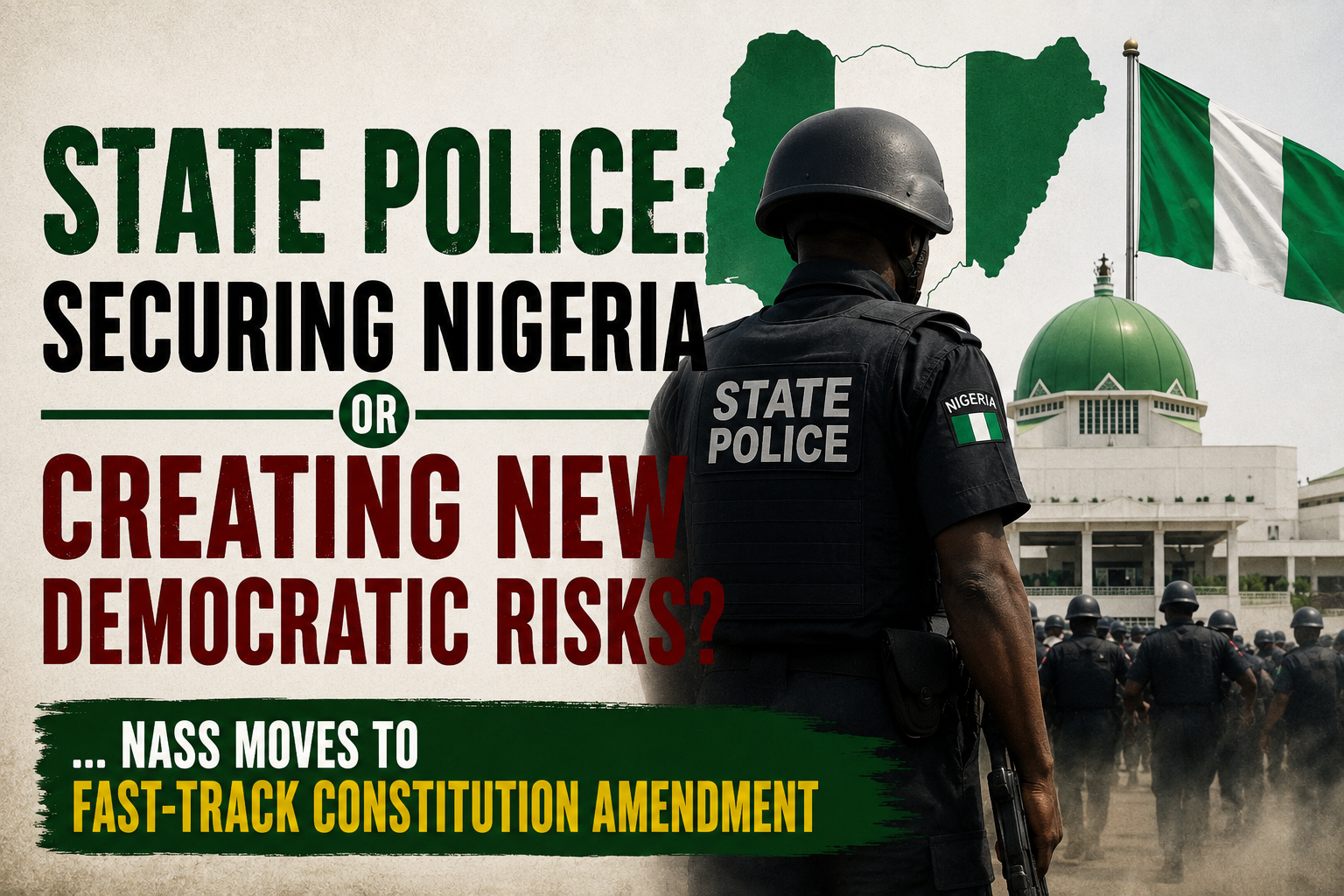
… NASS Moves to Fast-Track Constitution Amendment
The National Assembly appears set to take one of the most consequential decisions in Nigeria’s constitutional history: whether to fundamentally restructure policing by creating State Police.
Although more than forty constitutional amendment proposals are currently before the National Assembly—including proposals on women’s political representation, local government reforms, judicial reforms, electoral reforms, and devolution of powers—the State Police Bill has emerged as the most politically urgent and potentially transformative proposal.
The proposal, which may be voted upon within days, seeks to alter the Constitution to establish a dual policing structure comprising a Federal Police and State Police. It would also move policing from the Exclusive Legislative List to the Concurrent Legislative List, thereby enabling States to establish and operate their own police services under a national framework.
The debate over State Police is not new. It has surfaced repeatedly since Nigeria’s return to democratic rule in 1999. What is new, however, is the growing consensus that Nigeria’s worsening security crisis may no longer be effectively addressed through a single centrally-controlled police force.
The question before lawmakers is therefore straightforward but profound: Can State Police improve security without creating new threats to democracy and constitutional governance?
Why the Demand for State Police Has Grown
The push for State Police has largely been driven by Nigeria’s deteriorating security situation.
Across large parts of the country, communities face persistent threats from banditry, kidnapping, terrorism, communal conflicts, armed robbery, farmer-herder clashes, cult violence, and organised criminal networks. Vast rural areas remain under-policed, while response times by security agencies are often slow due to distance, manpower shortages, and operational constraints.
Nigeria’s current policing model remains one of the most centralised in the world. Operational decisions, recruitment, deployment, promotions, discipline, and strategic priorities are largely controlled from Abuja. Commissioners of Police are appointed centrally and are accountable primarily to the Inspector-General of Police rather than to State Governments.
Supporters of State Police argue that this structure has become increasingly inadequate for a federation of more than 230 million people.
They contend that security challenges differ significantly from State to State and require locally tailored responses. Criminal activities in Zamfara differ from those in Rivers, Lagos, Borno, Enugu, Plateau, or Ekiti. A uniform national approach may therefore be unable to respond effectively to local realities.
Advocates also point to the success of regional security initiatives such as Amotekun in the South-West, Ebube Agu in parts of the South-East, and various community-based security networks that have emerged in response to perceived gaps in federal policing.
According to supporters, State Police would bring law enforcement closer to communities, improve intelligence gathering, enhance local accountability, and create faster operational responses to crime.
The Strong Case Against State Police
Despite these arguments, opposition to State Police remains significant.
The principal concern is not policing itself but political abuse.
Nigeria’s political history contains numerous examples of the misuse of state institutions against political opponents. Critics fear that State Police could become instruments of political repression in the hands of powerful Governors.
A frequently cited concern is the possibility that Governors may deploy State Police to intimidate opposition parties, harass critics, suppress protests, interfere with local elections, influence traditional institutions, or target perceived political adversaries.
These fears are not entirely speculative.
Even under the current federal policing system, allegations of political interference in policing have periodically arisen. Critics argue that creating police services directly answerable to State Governments could amplify these risks, particularly in States where democratic institutions remain weak.
Another concern relates to minority rights.
Some fear that State Police could be captured by dominant ethnic, religious, or political interests within particular States and used to marginalise minority communities.
Others question whether many States possess the financial capacity to sustain professional police organisations capable of paying salaries, maintaining equipment, funding investigations, supporting forensic capabilities, and providing adequate training.
A poorly funded State Police system, critics warn, could become vulnerable to corruption, political capture, and criminal infiltration.
The Electoral Question
Perhaps the most sensitive concern relates to elections.
Nigeria’s electoral history demonstrates that control of security agencies can significantly influence electoral outcomes.
The deployment of police personnel during campaigns, voting, collation, and post-election periods has frequently generated controversy.
Opponents of State Police fear that Governors could deploy State Police to:
- Restrict opposition rallies;
- Intimidate political opponents;
- Influence local electoral processes;
- Manipulate voter mobilisation;
- Interfere with election monitoring activities;
- Create unequal security conditions for competing political parties.
This concern becomes particularly significant because Governors frequently exercise substantial influence over State institutions.
Without strong constitutional safeguards, critics argue, State Police could undermine electoral competitiveness and weaken democratic accountability.
For this reason, many constitutional scholars have argued that any State Police framework must contain special election-period restrictions, independent oversight mechanisms, and clear federal intervention powers where electoral abuse is alleged.
What Safeguards Does the Bill Provide?
The proposed amendment attempts to address some of these concerns.
The Bill establishes several oversight mechanisms intended to reduce political abuse.
First, while Governors would appoint Commissioners of Police, appointments would be made upon the recommendation of the Federal Police Service Commission and would require confirmation by State Houses of Assembly.
Second, State Commissioners of Police may refer allegedly unlawful directives from Governors to State Police Service Commissions for review.
Third, the Federal Police Service Commission would retain authority to prescribe national policing standards, supervise compliance, and conduct periodic certification reviews of State Police operations.
Fourth, the Bill allows Federal Police intervention where there is a complete breakdown of law and order, where a State requests assistance, or where a State Police becomes incapable of functioning.
Finally, the Bill creates State Police Service Commissions with representation from the National Human Rights Commission, Nigerian Bar Association, Nigerian Labour Congress, Public Complaints Commission, retired police officers, and journalists.
These provisions represent an attempt to balance State control with national oversight. However, significant questions remain regarding how effectively these safeguards would operate in practice and whether they are sufficient to prevent political interference.
The Missing Safeguards
Even supporters of State Police acknowledge that additional protections may be necessary.
Among the safeguards that may warrant consideration are:
- Independent election-period command arrangements;
- Explicit constitutional prohibitions against partisan policing;
- Mandatory human rights compliance standards;
- Independent civilian complaint mechanisms;
- National use-of-force standards;
- Federal judicial review of politically sensitive directives;
- Strong whistleblower protections for police officers;
- Legislative oversight reporting requirements;
- Transparent recruitment processes based on merit and federal character principles;
- Independent auditing of State Police operations.
The success or failure of State Police may ultimately depend less on whether they are created and more on whether such safeguards are effectively implemented.
The Real Question Before Nigeria
The debate should not be framed as a choice between security and democracy.
Nigeria requires both.
The country’s worsening insecurity demands innovative and effective policing arrangements. At the same time, democratic institutions must be protected from political abuse.
The challenge before the National Assembly is therefore to design a State Police framework capable of improving public safety while preserving constitutional freedoms, political pluralism, human rights, and electoral integrity.
The proposed constitutional amendment represents perhaps the most significant restructuring of Nigeria’s internal security architecture since independence.
If properly designed, adequately funded, professionally managed, and subjected to robust oversight, State Police could strengthen public security and deepen federalism.
If poorly designed, however, they could create new centres of coercive political power and generate fresh threats to democratic governance.
The coming vote in the National Assembly is therefore about far more than policing. It is about defining the balance between security, federalism, accountability, and democracy in Nigeria’s constitutional future.