
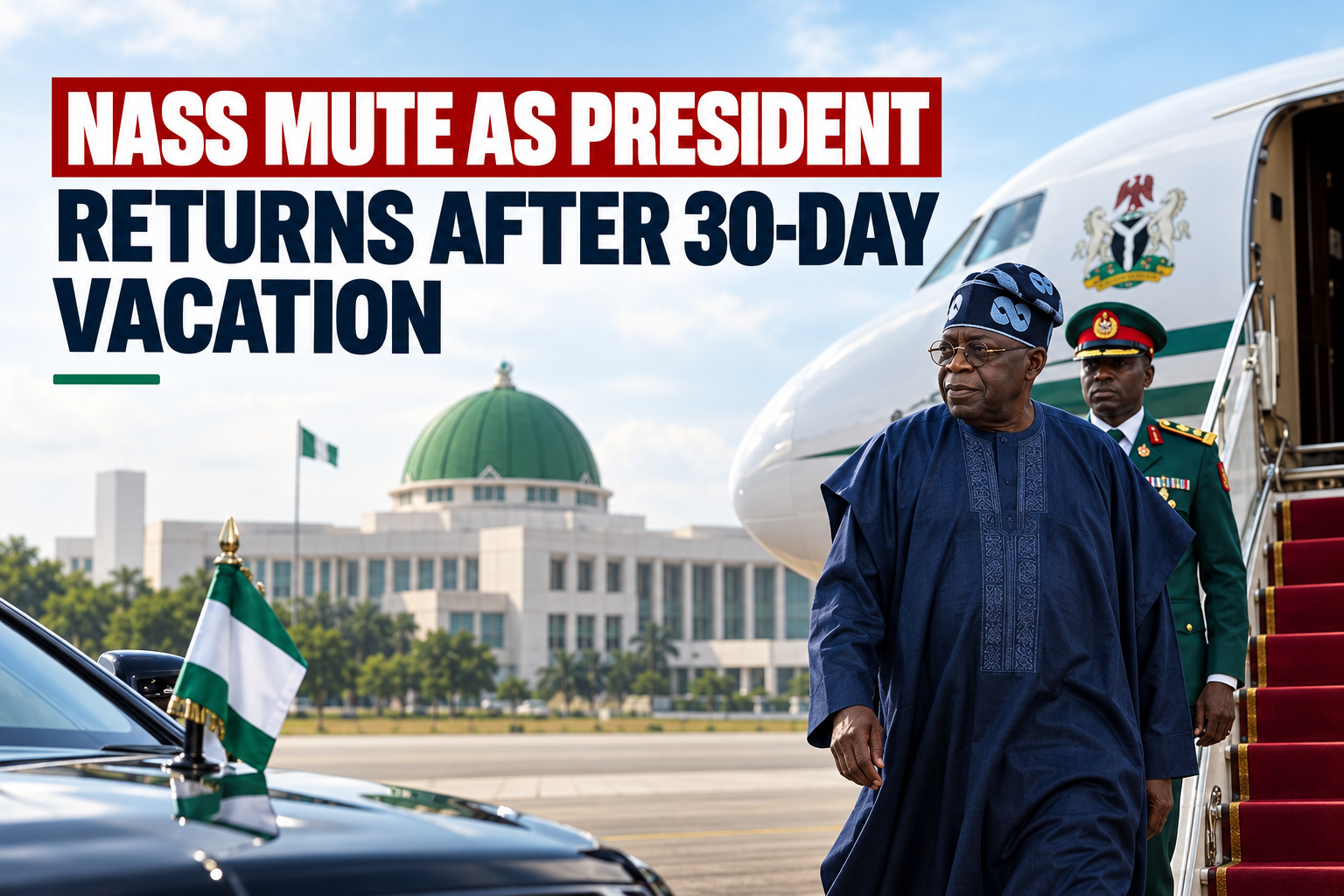
President Bola Ahmed Tinubu has returned to Nigeria after a 30-day absence, but the National Assembly has remained silent on whether the constitutional procedure governing presidential absence was followed and what action, if any, it took during his absence.
President Tinubu left Nigeria on 30 August 2026 for what was initially announced as a three-week “working vacation” in London and Paris. He returned to Nigeria on 29 September 2026 and remained in Lagos until 5 October 2026, when he returned to Abuja.
Section 145(1) of the 1999 Constitution requires the President to transmit a written declaration to the President of the Senate and the Speaker of the House of Representatives when going on vacation or otherwise unable to perform the functions of his office. Until another written declaration is transmitted stating that he has resumed those functions, the Vice-President acts as President.
Section 145(2) of the 1999 Constitution provides that where the President fails to transmit the required declaration within 21 days of his absence or inability to perform his functions, the National Assembly shall, by simple majority resolution, require the Vice-President to perform the functions of the office.
With the President’s absence extending beyond the 21 days specified in Section 145(2), the National Assembly had a Constitutional responsibility to act, yet it has provided no public account of what action it took.
Where Was the National Assembly?
The Presidency has argued that the President could continue to perform his functions from outside Nigeria. Section 145(1), however, requires a written declaration and provides for the Vice-President to perform the President’s functions as Acting President until the President transmits a written declaration confirming his return or ability to discharge his functions.
For part of the President’s absence, both the President and Vice-President were outside the country. Who, then, was exercising the functions of the executive government during that period? The National Assembly remained silent.
The 21-day period under Section 145(2) also passed without the National Assembly passing the required resolution after the written declaration was not transmitted.
The National Assembly has given no public explanation for its inaction or indicated whether it established that the Constitutional requirements had been met, leaving the public to piece together statements from the Presidency and reports of the President’s movements to determine whether those requirements were followed.
When Oversight Becomes Silent
The National Assembly is one of the institutions through which executive power is checked, and its role is particularly important where the Constitution gives it a specific responsibility when its requirements are not followed.
Section 145(2) assigns the National Assembly a Constitutional duty where the written declaration required when the President is on vacation or unable to discharge the functions of his office is not transmitted within 21 days. The declaration was not transmitted, the 21 days passed, and the National Assembly remained silent.
Constitutional safeguards depend on the institutions responsible for giving effect to them. Oversight cannot be conditional on political convenience, and a Constitutional provision offers little protection when the institution required to enforce it does not act.
President Tinubu has returned to Nigeria, but his return does not resolve what happened during his absence or explain the National Assembly’s failure to respond. The episode exposes the gap that can emerge between Constitutional rules and the institutions expected to uphold them.
A democratic system is only as strong as its institutions’ willingness to enforce the limits placed on power.