
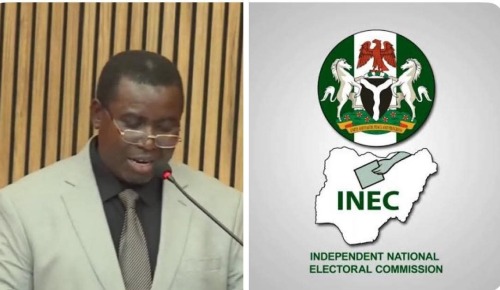
Public confidence in Nigeria’s electoral umpire is again under strain.
Barely months into the build-up to the 2027 general elections, the Independent National Electoral Commission (INEC) is already facing a cluster of controversies that have revived familiar questions about its independence, neutrality and internal decision-making.
In recent weeks, the Commission has had to defend its handling of the African Democratic Congress (ADC) leadership dispute, step back from a planned nationwide voter revalidation exercise, and respond to allegations that a partisan X account was linked to its Chairman, Professor Joash Ojo Amupitan, SAN.
Taken separately, each issue may appear manageable. However, taken together, they point to a deeper problem, which is that INEC is entering another election cycle with public trust still fragile.
The ADC dispute and accusations of bias
One of the latest controversies arose from INEC’s decision in relation to the leadership dispute within the African Democratic Congress.
Reports indicate that INEC removed the names of Senator David Mark and Rauf Aregbesola from its list of recognised ADC officials, citing court processes and the need to comply with judicial orders. The decision triggered sharp criticism from sections of the opposition, with some ADC leaders accusing the Commission of bias and calling for the removal of the INEC Chairman. INEC, however, maintained that it acted in line with court decisions and insisted that its leadership cannot be removed outside the constitutional process.
Politically, the incident has already reinforced a recurring perception problem i.e., INEC’s administrative decisions, even if legally justified, are often interpreted through the lens of partisan advantage.
For an electoral body, perception matters. A decision may be lawful and still require clearer public explanation where it affects party organisation, political competition or access to the electoral process.
The suspended voter revalidation exercise
INEC also recently suspended arrangements for a planned nationwide voter revalidation exercise.
The Commission had earlier announced plans to begin the exercise from 13 April to 29 May 2026 as part of efforts to update the voter register ahead of the 2027 elections. However, it later directed Resident Electoral Commissioners to step down publicity and arrangements for the exercise and await further directives.
This reversal raised questions about planning, timing and communication. Voter register credibility is central to electoral integrity. Any major exercise affecting the register must therefore be carefully explained, especially where it is introduced close to an election cycle and then abruptly suspended.
The issue is not simply whether INEC has the power to update the register, which it does. The larger concern is whether such sensitive processes are being communicated with enough clarity to avoid confusion, suspicion or politicisation.
The X account controversy
It is against this wider backdrop that the controversy over an alleged X account linked to Professor Amupitan emerged.
The allegation centred on an account said to have used his name and allegedly engaged in politically suggestive interactions during the 2023 general election period. The draft under review notes examples including responses such as “Victory is sure” and “Asiwaju” to politically charged posts, as well as claims that the account handle was later changed and made less publicly accessible.
INEC has denied that the Chairman owns or operates the account. The Commission also said a forensic review cleared him of the allegation, describing the account claims as manipulated and false.
Still, the controversy has not disappeared. Part of the reason is that INEC has reportedly declined to publicly identify the forensic expert involved, stating that the matter has been handed to the police and that disclosure could interfere with investigation.
That explanation may be procedurally understandable, but it also leaves a public confidence gap. In a politically sensitive environment, an internal review by the same institution under scrutiny is unlikely to fully settle public doubt.
The confirmation process under scrutiny
The Amupitan controversy is not only about whether one social media account is real or fake. It raises a broader institutional question of how carefully are nominees for INEC leadership scrutinised before confirmation?
Professor Amupitan was screened and confirmed by the Senate in October 2025. Lawmakers reportedly questioned him on electoral reform, technology, institutional strengthening and claims that he had been involved in President Tinubu’s legal team at the 2023 Presidential Election Petitions Tribunal, which he denied. Security agencies were also said to have cleared him before confirmation.
But the present controversy suggests that screening should not only respond to allegations already in circulation. For an office as sensitive as INEC Chairman, confirmation should include proactive due diligence on publicly available records, including digital footprint, political associations and public commentary that may affect perceptions of neutrality.
The appointment question remains
The controversy also returns attention to the appointment process itself. Under the Constitution, the President appoints the INEC Chairman, subject to Senate confirmation. Critics have longargued that this creates a perception problem because the President is usually a direct stakeholder in elections conducted by the Commission.
That concern is not new. The Justice Uwais Electoral Reform Committee recommended in 2008 that the process be further insulated from executive influence, but this recommendation has never been fully implemented.
The larger point is that INEC’s independence cannot rest only on formal appointment and security clearance. It must be supported by a confirmation process, appointment structure and public accountability system strong enough to assure citizens that the electoral umpire is not politically beholden to those it is meant to regulate.
Why this matters before 2027
The 2027 elections are still ahead, but the credibility contest has already begun. For INEC, the challenge is not only to conduct elections. It must also convince citizens, parties and candidates that its decisions are neutral, lawful, transparent and consistent.
This requires more than denials. It requires timely explanations, transparent procedures, stronger public communication and institutional safeguards that reduce suspicion before it hardens into distrust.
The recent controversies may fade individually, but collectively, they are a warning. As Nigeria moves closer to 2027, INEC’s greatest test may not only be logistics, technology or the voter register. It may be whether the Commission can rebuild public trust before the first ballot is cast.